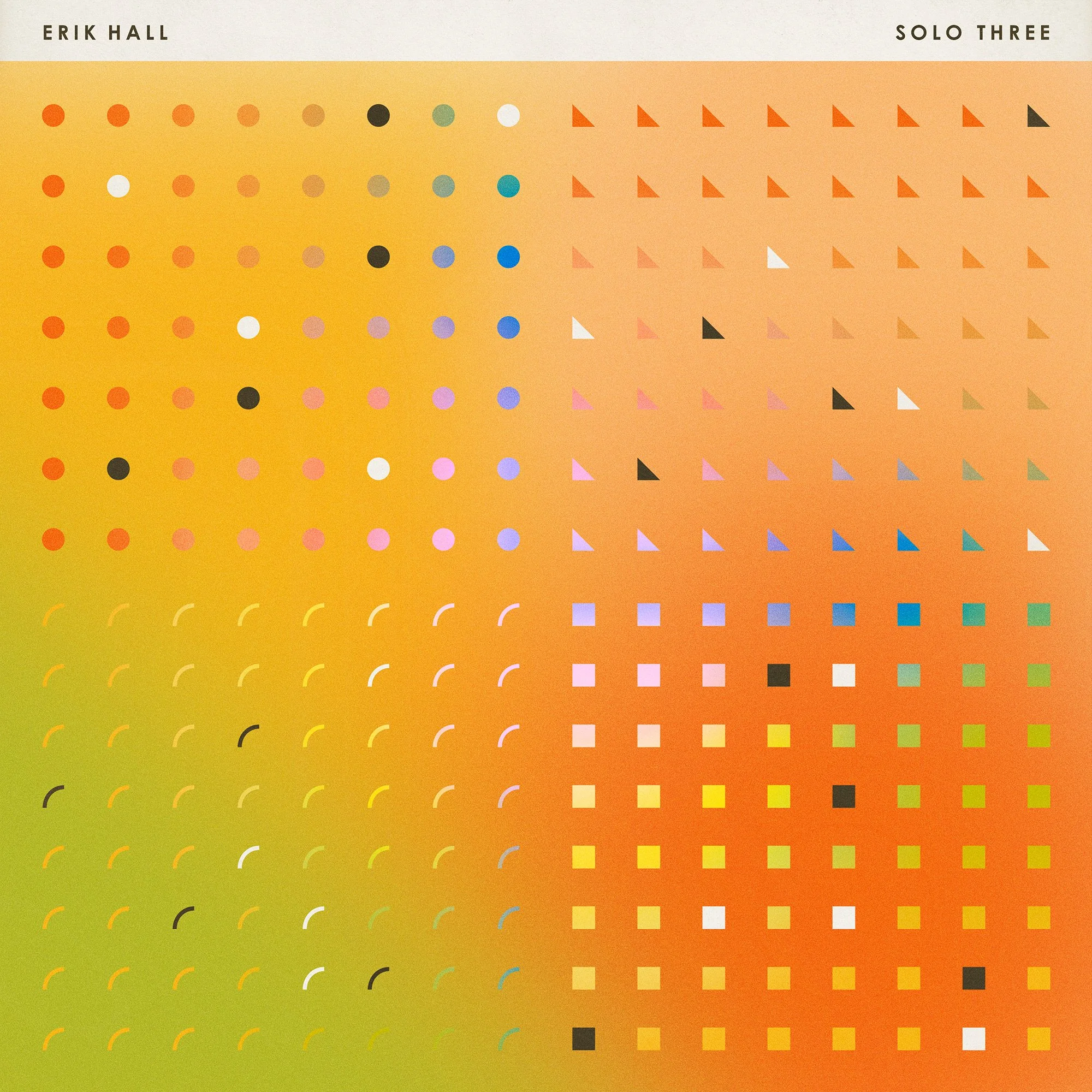
SOLO THREE
2026, Western Vinyl
Performed, recorded, and mixed by Erik Hall at home in Galien, Michigan, Fall 2024, using a Yamaha spinet piano, Hammond M-101 organ, Rhodes electric piano, Moog Sub 37 synthesizer, Nord Lead synthesizer, electric guitar, and electric bass
1. The Temple of Venus Pt. 1 (Glenn Branca)
© 1990 Glenn Branca / Reg Bloor Music (BMI)
Commissioned by E. Monte Motion, Inc., Elisa Monte, Artistic Director (with assistance of a major grant from Meet The Composer)
2. Strumming Music (Charlemagne Palestine)
© 1974 Charlemagne Palestine (SABAM)
3. A Folk Study (Laurie Spiegel)
© 1975 Laurie Spiegel / Laurie Spiegel Publishing (ASCAP)
4. Music for a Large Ensemble (Steve Reich)
© 1978 Hendon Music Inc. (BMI) c/o Concord Music Publishing
Mastered by Warren Defever at Third Man Mastering, Detroit, MI
Artwork and layout by Aaron Lowell Denton
BANDCAMP | SPOTIFY | APPLE MUSIC
There is a certain solace to be found in minimal music—a contemplative joy that emerges through sustained repetition and subtle variation. Solo Three, the slyly absorbing new album from Michigan-based composer and multi-instrumentalist Erik Hall, embodies that hypnotic charge while boldly reimagining a distinct selection of contemporary classical works.
Hall’s affinity for minimalism began decades ago, when as a jazz-studies drummer at the University of Michigan he first encountered Steve Reich’s Music for 18 Musicians. The piece altered his trajectory completely. Years later, amid a creative lull, he revisited that formative work by attempting a solo reconstruction. Working alone in his home studio, Hall painstakingly recreated Reich’s intricate, interlocking architecture—supplanting the piece’s orchestral palette with his own keyboards, guitars, and synths—and performing every part himself without loops, programming, or sequencers.
That recording, released on Western Vinyl in 2020, arrived during the fraught early months of lockdown and resonated deeply with listeners. Pitchfork praised it for making “a minimalist standard freshly thrilling to revisit,” and it won the 2021 Libera Award for Best Classical Record. Even Reich himself wrote to congratulate Hall, saying he had “reinvented the piece.”
Heartened, Hall next turned to Simeon ten Holt’s Canto Ostinato, a sprawling work of Dutch minimalism built on repetition and euphoric harmony. His 2023 interpretation was hailed by Bandcamp Daily as “mesmerizing as patterns emerge, coalesce, and retreat,” and the New York Times highlighted Hall in a feature on ten Holt’s growing influence. The project led to a years-long collaboration with New York’s Metropolis Ensemble and Sandbox Percussion, confirming Hall’s place as an inventive new voice bridging classical and contemporary practice.
With Solo Three, Hall brings this trilogy to a sweeping close. Instead of focusing on a single composition, he weaves together multiple works by several visionary composers: Glenn Branca, Charlemagne Palestine, Laurie Spiegel, and a return to Steve Reich. The result is a rich, varied homage to American minimalism—at once reverent and exploratory. Branca’s “The Temple of Venus Pt. 1” unfolds in oscillating organ and prepared piano; Palestine’s “Strumming Music” becomes a meditative blur of felted piano and guitar; Spiegel’s “A Folk Study” is recast with acoustic warmth in lieu of electronics; and Reich’s “Music for a Large Ensemble” closes the album with a 16-minute, kaleidoscopic rush of overlapping melodies and jubilant rhythmic patterns.
True to his method, Hall performs and records every part himself, layering instruments one by one like sonic bricks. The approach is deeply human and quietly defiant in an age of faceless automation. “It’s just so much more compelling to actually play every note,” Hall says. “Those micro-differences between takes create a sort of living, breathing magic.”
That living, breathing magic fills every corner of Solo Three. It’s both a reverent ode to the composers who shaped Hall’s musical identity and a vivid reminder that minimalism’s hypnotic beauty—its patience, precision, and quiet emotional power—still speaks urgently to the present moment.
- Zach Schonfeld